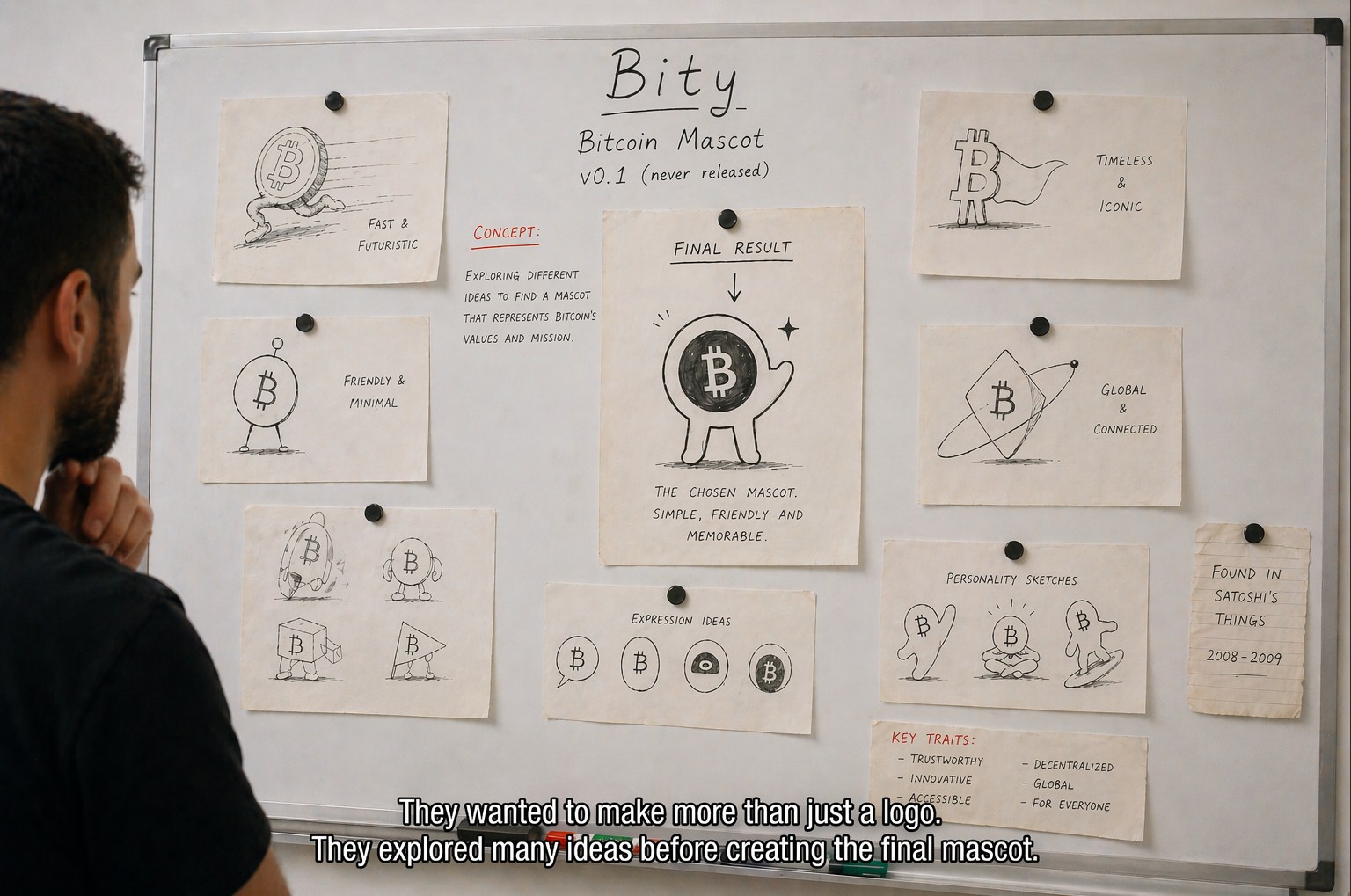
The long-awaited documentary "Finding Satoshi", which premiered today, has delivered one of the most surprising moments in the history of Bitcoin coverage: the on-screen reveal of what the film presents as the very first Bitcoin mascot — a small, round character with a stubby body, a beaming bitcoin-symbol face, and a pair of tiny arms, designed as a friendly visual ambassador for the then-unknown protocol.
The character — informally known in the film as "Bity" — had never been shown publicly before. According to the documentary, the concept sketches were discovered among a set of early personal files dated between 2008 and 2009, during the period when Bitcoin's whitepaper was being finalized and the first blocks were being mined.
The 48:33 Moment
The reveal comes roughly 48 minutes and 33 seconds into the film, in what is shaping up to be the documentary's most talked-about scene. After building a careful investigative arc through interviews with figures like Michael Saylor, Fred Ehrsam, Joseph Lubin, and Brian Brooks, the camera cuts to a whiteboard in a private room where investigator Tyler Maroney and journalist William D. Cohan lay out a series of hand-drawn sketches under the title "Bity — Bitcoin Mascot v0.1 (never released)."
The board lays out the design process with striking clarity. Pinned around the central "FINAL RESULT" sketch are a series of rejected concepts — a "Fast & Futuristic" running bitcoin, a "Friendly & Minimal" round variant, a caped "Timeless & Iconic" version, and a "Global & Connected" bitcoin orbiting a network diagram. In the bottom-right corner, a yellow sticky note simply reads: "Found in Satoshi's things — 2008–2009."
A Mascot That Never Made It Out
According to the film, Bity was never released, never published online, and never referenced in any known Bitcoin forum post or mailing-list message. The filmmakers frame the discovery as a small but telling artifact — evidence that whoever was behind Satoshi Nakamoto considered, at least briefly, giving the protocol a face.
The concept notes on the board spell out the design philosophy in a single red-inked heading: CONCEPT — "Exploring different ideas to find a mascot that represents Bitcoin's values and mission." Beneath the chosen mascot, a handwritten caption reads: "The chosen mascot. Simple, friendly and memorable."
A second note, labeled KEY TRAITS, lists the qualities the designer was aiming for:
- Trustworthy
- Innovative
- Accessible
- Decentralized
- Global
- For everyone
A smaller panel on the board — labeled "Personality sketches" — shows Bity in three moods: a gloved, waving version; a cross-legged, meditating version; and a smaller, shy variant peeking out from behind a curve. A fourth panel, titled "Expression ideas," lays out how Bity might communicate without words: a speech bubble, a surprised look, a closed-eyed calm, and a glowing variant.
Why This Matters
"It doesn't change Bitcoin. It doesn't change the code. But it changes how we think about the person — or people — who started this. Whoever they were, they cared enough to sit down and try to draw a face for it." — William D. Cohan, in the film
For more than fifteen years, Bitcoin has lived almost entirely as a technical and financial artifact — a protocol, a whitepaper, a chain of blocks. It has no official logo committee, no brand guidelines, and no mascot. The orange "₿" symbol, which became the de facto visual identity for the asset, was itself adopted informally by the community long after Satoshi's disappearance.
The discovery of Bity, if accepted at face value, suggests that the earliest thinking around Bitcoin was not only technical but also — even briefly — human. A character. A personality. A small, round, smiling face meant to make a radical financial experiment feel approachable to ordinary people.
Community Reaction
Within minutes of the 48:33 scene leaking in clips across social media, the crypto community responded with the kind of energy usually reserved for halving events. On X, the hashtag #Bity began trending alongside #FindingSatoshi, with fan art, merchandise mock-ups, and meme edits appearing in real time.
Prominent early Bitcoiners weighed in quickly. Several noted that while the authenticity of the sketches will inevitably be debated, the spirit of the character — playful, minimalist, and unmistakably rooted in the early Bitcoin aesthetic — feels right for the era it supposedly came from.
"If Satoshi really did doodle a mascot and then decided not to ship it, that's maybe the most Satoshi thing I've ever heard." — Jameson Lopp, paraphrased from a post-screening reaction
What the Filmmakers Say
The documentary — produced alongside investigators at Quest Research & Investigations — treats the Bity discovery carefully. The filmmakers do not claim the sketches are definitively by Satoshi. Instead, they frame them as "recovered from materials consistent with Satoshi-era files," and leave the final judgment to the viewer.
The decision to show the mascot at all was, according to the film's own narration, not taken lightly. Cohan describes the moment as "a small piece of humanity in a story that has, for too long, been told as pure cryptography."
A New Chapter for Bitcoin Iconography
Whether or not Bity is eventually embraced by the community, the mascot's on-screen debut marks a genuine first. Never before has a character purporting to be an original Bitcoin mascot been shown in a public film — let alone one tied directly to the investigation into Satoshi's identity.
For some, the reveal will feel like a long-overdue emotional anchor for an asset class that has spent most of its life defined by charts, code, and controversy. For others, it will simply be a charming historical footnote — a tiny, round face that was almost the public avatar of the most consequential financial invention of the 21st century.
Either way, for a few seconds at the 48-minute mark of "Finding Satoshi," Bitcoin had a face. And for a community that has spent years searching for its creator, even a cartoon smile feels, for now, like an answer.